

Latest News
European Focus Can Boost Offshore Wind in 2026
Challenges in offshore wind have prompted many developers to focus more on core markets in Europe in 2026, and this may drive greater collaboration on safety, according to Steve Cook, HSEQ Manager at Reventus Power.
Rising costs, failed auctions, and U-turns by previously supportive governments caused difficulties for companies throughout the offshore wind supply chain last year.
The result is that more developers appear to be focusing on established markets in 2026. At Reventus Power, for example, we are concentrating primarily on core markets in northern Europe, including the UK. From a safety standpoint, we would expect this to drive collaboration across the supply chain and help us make projects safer as well as more profitable.
Europe was not immune to troubles in 2025. Financial challenges for developers and operators led to a disconnect with policymakers and contributed to the postponement or cancellation of a host of major tenders. Belgium, Denmark, Estonia, France, Germany, Lithuania, and the Netherlands were all affected. The industry is now responding.
From a safety perspective, the sector must also take seriously the impacts of slimmer profits in areas such as project health and safety, environmental standards, and quality assurance. Lower profits often mean these vital areas receive less attention, and that original equipment manufacturers have less money to spend on technology improvements to boost standards. This can lead to increased pressure on project timelines, meaning companies must operate with leaner teams.
The race by manufacturers to build larger and more complex turbines has led to a lack of standardisation across wind farms. Numerous projects end up using different turbines and foundations, which means different lift mechanisms, ladder systems, and so on. This is important because it means offshore technicians are frequently working in potentially unfamiliar environments, introducing greater potential for human error. Standardisation would help improve this, alongside a greater focus on training standards for workers.
But I am hopeful. The increased focus on Europe by major utilities and developers may drive collaboration that boosts standardisation, making life offshore easier and safer. With Chinese manufacturers like Ming Yang making inroads in Europe, it would be great to see Western manufacturers like Siemens Gamesa, Vestas, and GE Renewable Energy working to standardise approaches to cut costs and boost safety.
This can only help the industry and improve the financial credentials of projects.
HSEQ Certification
Reventus Power places a strong emphasis on health, safety, environmental, and quality (HSEQ) assurance, compared with many investors in the sector. We have taken the time to secure accredited certification in three key areas to help us support effective project delivery.
We do not deliver the safety on projects ourselves, but we want to ensure projects we are involved with comply with the highest standards. As a dedicated global offshore wind platform, we invest flexibly and at scale across the whole asset life cycle. We also oversee a large number of projects – both in our portfolio and future opportunities – so it is helpful for us to bring not just a strong balance sheet, but also robust technical competence.
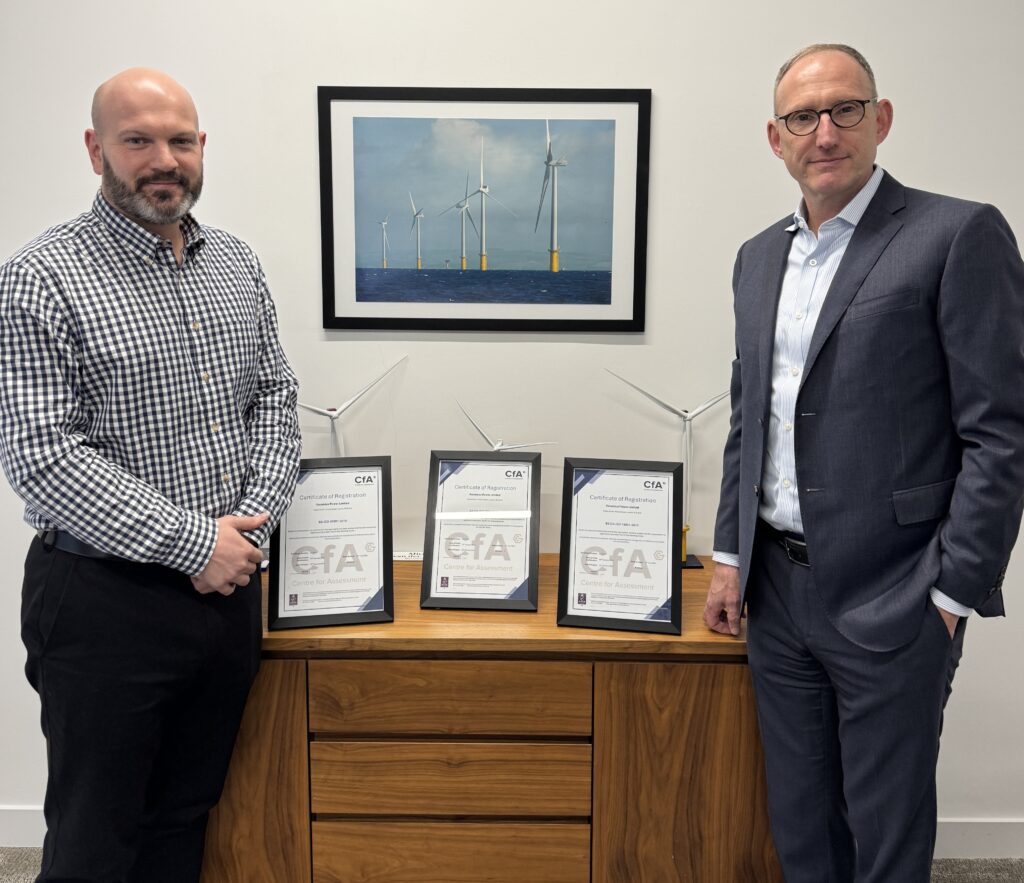
Reventus has successfully achieved industry accreditation for:
- Occupational Health and Safety – via ISO 45001
- Environmental Management – via ISO 14001
- Quality Management – via ISO 9001
These rigorous standards are overseen by the UK Accreditation Service (UKAS) and focus on areas essential to project safety and success. To meet the standards, Reventus has created a management system that meets all mandatory requirements and ensures that high standards for project delivery are embedded in our operations.
These are not simply pieces of paper. Being certified to these standards shows all of our current and future partners that Reventus is highly credible, working to best practice, and that we take these issues seriously enough to secure third-party verification that we operate to international standards. That is simply good business.
To achieve accreditation, UKAS takes a deep dive into our methods and practices every three years in a process that lasts 7–10 days at a time. They check that our risk assessments are correct, that facilities are being managed properly, we are conducting management reviews, and that we are setting the right objectives, communicating well, and doing the right reporting. This full audit gives all our partners huge confidence.
It is unusual for an investor to look at these areas in such depth. An investor would not usually have a safety resource like me in the room, but this makes Reventus able to contribute practically on projects too. Investors’ business metrics and KPIs typically look at financial returns rather than safety performance, operational quality, and the planning of projects. This demonstrates how we take a different approach, merging those aspects of technical competence with a strong balance sheet.
The industry can only benefit if more companies take these issues seriously. We need to find ways to reduce safety risks on site. One way to do that is by fostering greater cooperation to increase standardisation. With more major offshore players focused on the industry’s European heartland, we hope that 2026 will lead to more collaboration.
If we get that right, we can all help set operational benchmarks for the coming decades.